
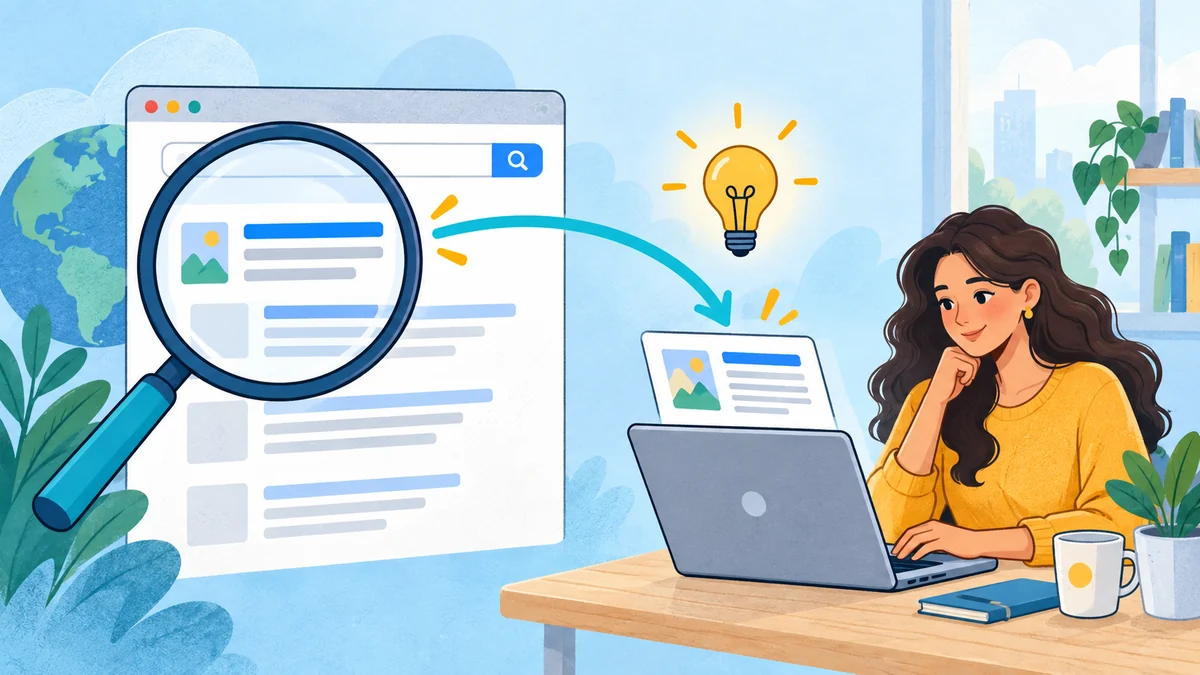
SEO stands for search engine optimisation. It is the work of making your website easier for search engines to discover and understand, while helping the right people find information, products or services that meet their needs. You do not pay a search engine for each organic click, although creating and improving your website takes time, effort and sometimes money.
That definition is useful, but it does not tell you what to do when you open your own website. Should you write a blog, change a title, install a plugin or hire someone? Before choosing a task, you need to understand what your page is supposed to help someone do. Otherwise, SEO can become a collection of changes with no clear purpose.
In my teaching, I want you to understand the reason behind a recommendation. If we change something on a page, you should be able to explain which problem we observed, what evidence supports it and how we will assess the result. That is a much more useful foundation than memorising a list of SEO tasks.
What does SEO actually do for a website?
SEO connects what your website offers with what people are looking for. A person searching for “how to clean a wool rug” needs guidance. Someone searching for “professional wool rug cleaning near me” may be ready to hire a business. The subject overlaps, but the pages that would help those people are different.
For the first search, a useful page might explain safe cleaning steps, the limits of home treatment and when to call a professional. For the second, the visitor needs service details, the area covered, evidence of experience and a way to request a quote. Publishing an article about rugs does not automatically make it a suitable service page.
This is why I would ask you to describe the purpose of a page before discussing its keywords. Who is it for? What question should it answer? What should someone be able to decide after reading it? If those answers are unclear, adding more search terms is unlikely to solve the underlying problem.
How does SEO work?
Search engines need to discover pages, process their content and decide which results to show for a search. Google describes this through crawling, indexing and serving search results. A page being published does not guarantee that it will be indexed, and being indexed does not guarantee prominent visibility.
Your SEO work supports that process by addressing access, relevance and usefulness. Google’s SEO Starter Guide is a useful starting reference for these fundamentals. For a beginner, I would turn them into three practical questions: can the page be found, does it serve a clear need, and is it useful enough for someone to act on?
Can the page be found and accessed?
Imagine creating a detailed service page but leaving it disconnected from your navigation and other relevant pages. A visitor browsing your website might never reach it. Checking how someone gets to that page is a straightforward first exercise, even before you learn to use a technical auditing tool.
I would open the homepage and try to reach the service naturally. If the route is confusing, we can inspect the navigation, category structure and relevant internal links. We would also check whether the page loads correctly. There is little value in refining its wording while visitors encounter an error instead of the content.
Does it match what the searcher needs?
The phrase “search intent” describes the purpose behind a search. Rather than treating it as another definition to memorise, ask what the person is trying to accomplish. Are they learning, comparing options, looking for a particular business or preparing to buy?
For example, a page targeting people who want to compare cleaning methods should help them weigh those methods. If it only repeats “book our cleaning service,” it leaves their comparison unanswered. A booking link can still be appropriate, but the page needs to earn that next step by doing the job the visitor arrived for.
Does it help someone make progress?
Useful content gives the reader something they can understand, assess or do. For a service page, that could mean explaining what is included and what information the business needs before quoting. For an educational article, it could mean showing a process with an example and explaining its limitations.
When reviewing a page, I would ask where a reader might still feel uncertain. “We provide excellent service” tells them very little. Explaining how an appointment works, what the service excludes or which situations need a different approach gives them information they can use.
What are the main types of SEO work?
You will often hear SEO divided into on-page, technical and off-page work, with local SEO relevant to businesses serving particular areas. These categories help organise the work, but a real website problem can involve more than one of them.
| Area | What you examine | Example task |
|---|---|---|
| On-page SEO | The purpose, content and presentation of a page | Rewrite an unclear heading and answer an important customer question |
| Technical SEO | How the website functions and how pages can be accessed | Investigate why an important page returns an error |
| Internal linking | How relevant pages connect within the site | Link from a practical guide to the service it helps a reader understand |
| Off-page SEO | Relevant references and links from other websites | Develop a useful resource that an industry organisation may choose to reference |
| Local SEO | How a business presents its services and location information | Clarify the actual areas served and keep business details accurate |
Do not read this table as a requirement to do everything immediately. If your main service page is inaccessible, that deserves attention before polishing an unrelated article. If the page works but never explains the service clearly, the content may be the more useful place to begin.
What does SEO look like in practice?
Consider a small cleaning business with a homepage, a contact page and several general cleaning articles. The owner wants more carpet-cleaning enquiries, but there is no dedicated page explaining that service. This is a hypothetical example, not a client result or a promise of performance.
My first step would be to understand the business. Does it actually provide carpet cleaning? Where? Which jobs can it accept? What do customers usually ask before booking? Those answers determine what a relevant service page should contain. Keyword research should then help us understand the language and questions people use around that offering.
We might recommend creating a dedicated carpet-cleaning page that explains the service, coverage, process and quote requirements. A relevant existing article could link to it where readers need professional help. The navigation should also make the service easy to find, and the enquiry route should work on a phone.
After implementation, we would record what changed and monitor the page. Relevant search visibility, visits and genuine enquiries would tell us more than simply counting how many new words we published. If visits increased but enquiries did not, we would investigate the visitor journey before deciding to write another batch of blogs.
This is the kind of thinking we practise in my 1:1 SEO and AI visibility coaching: use a real website, understand the problem and connect the recommendation to a purpose.
How do you know whether SEO is working?
Choose measures that match the purpose of the page. A beginner’s guide may help relevant readers discover your business and explore another useful resource. A service page may be intended to generate qualified enquiries. Judging both only by total traffic can hide whether they are doing their jobs.
I would keep a simple record of the page, the change, the date and the outcome we want to observe. For a service page, that might include search impressions, clicks and enquiries, alongside notes on whether those enquiries concern the service and location you actually support. You can then compare periods while considering seasonality, other marketing activity and changes in demand.
Avoid treating one rising number as proof that every SEO decision was correct. A campaign might attract attention without attracting suitable customers. Equally, a small number of highly relevant enquiries may matter more to a specialist business than a large audience seeking unrelated information.
Is SEO still relevant to AI search?
SEO remains relevant when search experiences include AI-generated answers. For Google’s AI Overviews and AI Mode, Google says its existing SEO practices still apply and there are no additional technical requirements specifically for appearing in those features. Eligibility does not guarantee inclusion. You can read the details in Google’s guidance on AI features and websites.
I would therefore be cautious about buying an “AI visibility package” without understanding what work it includes. Ask which pages need improvement, what the evidence is and how progress will be measured. Clear explanations, credible supporting information and an accessible website are sensible priorities, but no consultant controls whether an AI system mentions your business.
For your own learning, start with the relationship between a question and a useful page. Then examine how different search experiences present information. You do not need to abandon the fundamentals each time a new label appears.
Common questions about SEO
Can I do SEO myself?
Yes. You can begin by clarifying page purposes, improving useful content, checking navigation and learning to interpret your website’s data. You may still need specialist help for development work, complex technical problems or a large migration. Understanding the basics also helps you recognise when a task exceeds your current skills and ask better questions when hiring support.
Do I need to know coding to learn SEO?
You can learn many SEO skills without coding. Research, content review and basic editing can often be practised through a content management system. Technical knowledge becomes more valuable when you need to diagnose how a website is built or behaves. Learn enough to understand the recommendation, and involve a developer when implementation requires expertise you do not have.
Is SEO free?
Organic search does not work on a payment-per-click basis, but SEO still has costs. Someone needs to research, write, implement and review the work. If you do it yourself, your time is part of that investment. If you hire help, assess the scope and reasoning behind the work rather than assuming a higher number of monthly tasks means better value.
How long does SEO take to work?
There is no fixed deadline that applies to every website. Google notes that changes can take anything from hours to several months to be reflected in search results, and some changes may produce no noticeable improvement. Ask what is being changed, what outcome is expected and when it would be reasonable to review the evidence, rather than relying on a guaranteed timeline.
Do I need to publish blogs for SEO?
Blogging can help when articles answer relevant questions and support the purpose of your website. It is not automatically your first priority. A business with unclear or incomplete service pages may benefit more from improving those pages first. Publish an article because it has a useful role, rather than because a monthly package requires a certain number of posts.
Start by understanding one page
Choose one important page on your website. Describe who it serves, what that person needs and what the page should help them do. Then read it as someone encountering your business for the first time. Note what is missing, confusing or difficult to use, and separate those observations from assumptions that still need evidence.
That exercise gives you a starting point for learning SEO through decisions you can explain. If you want guidance applying it to your own website, explore my personal SEO lessons. We can work through your questions together and identify a practical next step. A 60-minute lesson is $47 USD.